

Whether you’re an entrepreneur launching a startup or a well-established business looking to scale, one thing never changes. You need customers, and more of them.
Marketing – and customer acquisition – is essential to the survival of any business. That’s why even the world’s largest corporations don’t rely on brand recognition alone. They spend millions on marketing, with good reason.
Obviously, marketing for its own sake (or for vanity) is pointless. The goal is to get people to buy your product or service. And for that to happen, you need to attract and steer them through a sales funnel.
Start With the End in Mind
Every piece of marketing material, every bit of brand collateral, should be designed to ultimately point a prospective customer toward a purchase. And to accomplish that, you need a well-designed marketing strategy and the best sales tools at your disposal.
Typically, there are four stages to consider when designing a marketing or sales funnel:
- Creating awareness of your offering.
- Encouraging consideration of the offer.
- Prompting conversion of a prospect into a paying customer.
- Ensure customer loyalty to stimulate repeat business.
A simpler way to articulate this would be to say that your goal is to attract, inform, convert, and engage people.
Most businesspeople are familiar with the basic structure of a sales funnel:
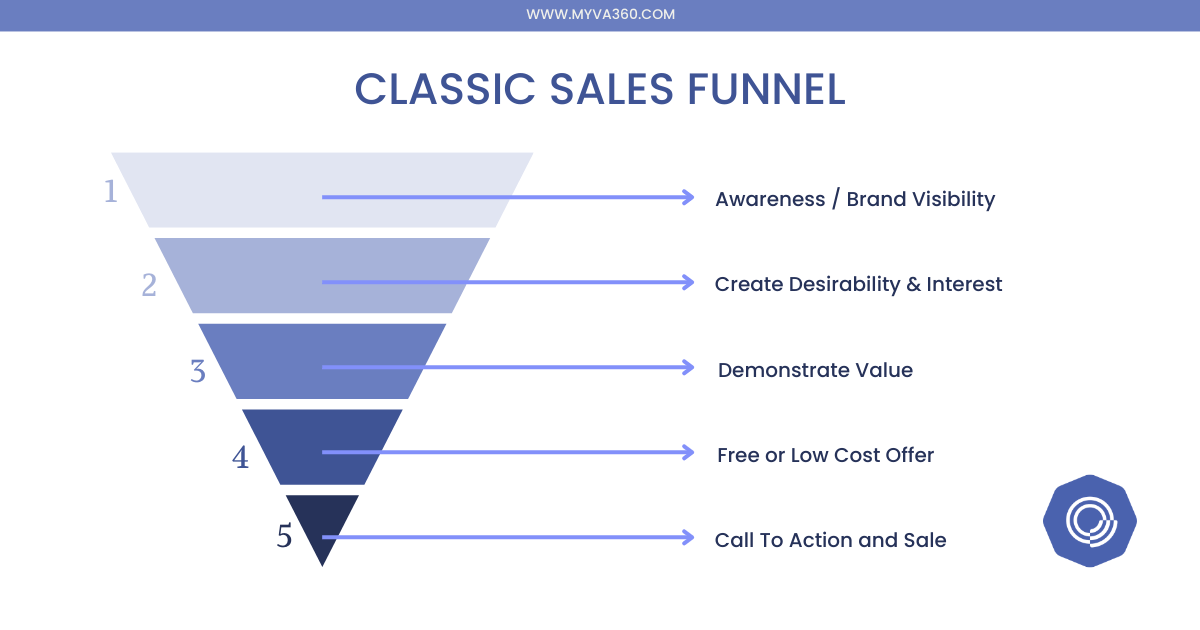
On its own, this process might seem simple. In reality, it requires constant monitoring and tweaking. A sales funnel is more than just a system. It’s the interactive process of building a relationship with a customer. Most of all, it requires hands-on time and expertise – and this is where a virtual assistant excels.
Smart Sales Tools: Automate Your Process Flow
As far as possible, you want to harness technology to automate your sales process. At each stage of your sales funnel, there are sales tools that can accomplish this for you. However, they still need constant monitoring and interaction to be effective.
The Best Sales Tools for the Job
For the purpose of simplicity, let’s divide your client sales journey into 3 key categories:
- The pre-sale stage.
- The sale.
- The post-sale stage.
For each of these stages, there are some very useful tools you may want to try out. Let’s take a look at some of the most popular sales tools, stage by stage.
The Pre-Sale or Prospecting Stage
Here, you’ll want tools that effectively spread your brand message and increase your visibility. The most obvious starting point is to harness the power of social media, by marketing to prospective clients where they congregate. A great way to do this comprehensively and effectively is to engage the services of a virtual assistant for social media management.
If you’re marketing broadly to the general public, then you may want to make use of social media management software to help create and automate your marketing material. Here, there are great choices. For a smaller company, you might want to look at Buffer (buffer.com), which offers both free and paid plans (starting at $6 per month per channel). Buffer offers post scheduling, engagement, analytics, and landing page capability.
For larger enterprises, there’s Hootsuite (hootsuite.com), the world’s largest social media management tool. It’s used by 18 million customers worldwide and more than eight hundred Fortune 1000 companies. Pricing starts at $99 per month – and it offers absolutely everything you need.
If you’re aiming for a more targeted approach – seeking out key individuals within an organization, for example – there’s a host of prospecting tools to help you. Here are 3 lead generation options to consider:
- Hunter (hunter.io) is a fantastic tool for finding email addresses of key contact persons within a company. This is a tool that offers a free and paid version (starting at $49 per month). It enables fully integrated email campaigns, too, along with team capability.
- Aeroleads (aeroleads.com) offers a similar suite of services – and is specifically geared to seamlessly interface with LinkedIn.
- Then, there’s Hubspot Sales Lead Software. This tool (from $45 per month) offers automated prospect list-building and real-time prospect tracking from your website. You can filter prospects by interaction or interests, along with automation that alerts you when a high-priority prospect engages with your site. There’s tons more, too, like automated email sequences.
The All-Important Sale
Want to skyrocket your conversion rates? There are tools to help you do just that. And to achieve consistency and manage growing numbers of clients, you’ll need a good CRM (Customer Relationship Management) system.
This is critically important.
In fact, according to LinkedIn’s 2022 Sate of Sales Report, 70% of top sellers said their CRM plays a critically important role in closing sales. So, what should you use?
- Once again, Hubspot Sales Hub features as a favorite, for several reasons. There’s a free and paid version, and you get some amazing tools. Contact management, reporting, email and meeting scheduling, task management, and reporting, all in one.
- Then, there’s Pipedrive, a CRM system designed by salespeople for salespeople. It’s intuitive, easy, effective, and perfectly suited to small businesses, with pricing from only $15 per month. This is a CRM suite that actually shows you which actions to prioritize in order to close a deal and make that sale.
- If you’re a solopreneur, you’ll love Salesflare. This CRM system is smart: it pulls data from social profiles, emails, and other sources, to build a record of the lead that enables you to target a prospect with precision. It also tracks prospect actions and prompts sales actions, enabling you to close sales at the right time. Starting at $35 per month, it’s well worth having.
Post-Sale Customer Retention
Successful customer retention means repeat sales and higher customer lifetime value. Going the extra mile here requires more than just outstanding service and ongoing communication.

There are several ways in which you can increase genuine customer engagement:
- You may want to consider implementing a customer loyalty program. Beyond VIP rewards or a points system, you could look at offering customer rewards for actions like posting reviews or referring friends. (We really like Yotpo.com – be sure to check it out.)
- You can also gamify your customer interaction by making use of an app or video game extension – this can build enormous customer trust and loyalty. For this, Mambo.io is a great tool to consider.
- Using drip campaigns is a great way to maintain continuous contact with existing clients – and automation is absolutely crucial for this. The more granular and personalized, the better.
Who Should Manage Your CRM?
As your business grows, looking after your customers will require more time and attention to detail – even if your CRM is automated. For a small or medium business owner, the most affordable way to do this is to make use of a skilled virtual assistant.
By doing so, you only pay for the time and expertise you need – while freeing up time, keeping overheads manageable, and scaling your business.
Book a discovery call with MYVA360 today – and discover how a virtual assistant can help you level up your business.